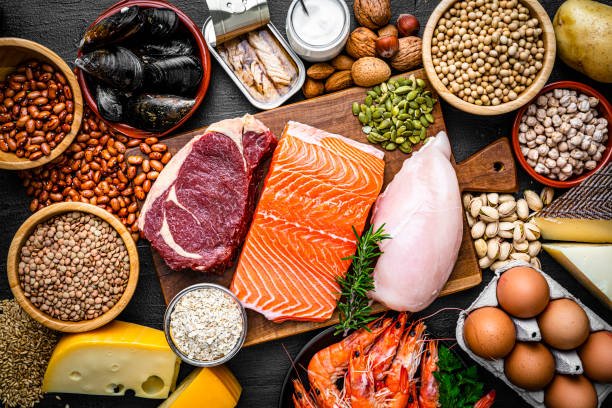
Amidst the controversy surrounding dietary protein regarding long-term benefits, optimal sources, and ideal intake, one thing is certain: most people simply are not eating enough.
Before we dive into adequate intake, let’s take a step back and discuss what protein is and why you absolutely need it.
What is Protein?
There are four macronutrients that form the foundation of nutrition: carbohydrates, fat, water, and protein. We’ll go into further depth regarding the other macronutrients in later blogs. Proteins are complex macromolecules consisting of amino acid chains that vary by their length and composition of the 20 existing amino acids. These amino acids are the fundamental building blocks that protein is broken down into during digestion and subsequently rebuilt through various anabolic pathways. Every physiological process requires these amino acids to form proteins that drive cellular activity, such as gene expression, immune response, and metabolism. Just as importantly, they form the proteins that compose every structure in the body; ranging from your hair and skin to muscle and bone (Wu, 2016). Your body naturally produces 11 of these amino acids, deemed nonessential amino acids. Therefore, the remaining 9 amino acids are called “essential amino acids (EAAs)” because they require dietary intake through sources such as meat, eggs, dairy, and soy (“Amino Acids”).
Why is Dietary Protein Important?
Consuming an adequate amount of protein containing a complete array of EAAs is essential for maintenance and synthesis of skeletal muscle. Your body has no means of storing excess protein, unlike carbohydrates and fat, which can be stored in the forms of glycogen and adipose tissue (body fat). Therefore, insufficient protein intake leads to catabolism (breakdown) of muscle (Drummond et al., 2016). Unless you’re a retiring offensive lineman, you can’t afford to lose muscle. There are innumerable benefits from gaining and preserving muscle mass, but to name a few:
- Enhanced strength and stability
- Preservation of physical autonomy and ability to perform day-to-day tasks
- Increased basal metabolic rate
- Muscle burns more calories than fat, supporting weight management and blood sugar regulation
- Increased insulin sensitivity
- Decreases the susceptibility to developing type 2 diabetes
- Reduced inflammation
- Muscle releases anti-inflammatory myokines during resistance training
- Lowered risk of cardiovascular disease
- Increased muscle helps regulate cholesterol levels, improve circulation, decrease adiposity, and lower blood pressure
- Lowered risk of cancer
- Anti-inflammation and regulation of blood sugar reduces cancer fueling factors
- Decrease fall and injury risk
- With improved stability and strength, injuries stemming from imbalance can both be mitigated and withstood(Mcleod et al. 2016).
- Mitigation of sarcopenia(age related muscle loss)
- Adults lose an average of 3–8% of muscle mass per decade after the age of 30. Building and preserving muscle can greatly reduce this(Wayne et al., 2012).
Overall, increased muscle mass facilitates a longer and healthier life. The health of your body leaves all your physical goals within your reach, whether it’s hitting a new bench press PR, running a marathon, playing soccer with your kids, or tying your own shoes.
How Much Protein Should You Consume?
I’m sure many of you have heard of the 0.8g of protein per kilogram of bodyweight Recommended Daily Allowance(RDA) established by the National Academy of Medicine. The 0.8 g/kg recommendation was derived from nitrogen balance studies that sought to determine the amount of protein necessary to maintain a basic nitrogen balance, preventing a protein deficiency. Through a multitude of flaws in these studies, ranging from measurement errors of nitrogen excretion to overestimation of metabolic efficiency, these studies underestimated how much protein the body actually requires(Elango et al., 2010). Additionally, people often misinterpret “Recommended Daily Allowance” as the optimal amount of protein to consume. A more accurate name would be “Minimal Daily Allowance”, as the RDA does not sufficiently support muscle growth, performance, metabolic health, or mitigation of age-related physiological decline(Lonnie et al., 2018).
The most recent meta-analysis conducted in 2024 examining muscle preservation in adults found that 1.2g of protein per kilogram of bodyweight substantially decreased the risk of sarcopenia and better maintained muscle mass compared to the outdated 0.8g/kg RDA. Regarding optimal growth, it is evident that there is a positive dose-response relationship between protein intake and muscle growth. Increasing protein intake from roughly 1.2 to 1.6 g/kg/day during resistance training produced 27% greater lean mass gains and 10% greater strength improvements, with benefits largely plateauing beyond this intake. In the cases of elite athletes, intakes of 2-2.2g/kg may be useful, but the benefits are marginal(Morton et al., 2018).
It is worth noting that while adequate protein intake can preserve muscle during short sedentary periods, hypertrophy via resistance training is necessary for muscle growth. Resistance training increases anabolic sensitivity, the ability to stimulate muscle protein synthesis in response to protein intake and hypertrophy. Sedentary lifestyles and aging primarily decrease anabolic sensitivity, requiring more protein to maintain the same degree of muscle preservation. A study was conducted where healthy adults in their early 20s immobilized one leg in a brace for 2 weeks while the other remained active. They found that not only did muscle mass and strength greatly decrease in the immobilized leg, anabolic sensitivity decreased by 27%(Wall et al., 2013). This demonstrated that physical activity, even at a young age, is critical for muscle growth and maintenance. Just as inactivity leads to anabolic resistance, adults typically begin developing anabolic resistance in their 40s as they age. A study comparing the protein synthesis dose-response between adult men in their 20s and 70s found that the older men required twice as much protein to achieve the same muscle protein synthesis as the younger men(Moore, 2014). It was shown that elderly individuals restored their anabolic sensitivity by 90% upon resistance training(Yang et al., 2012). In other words, consistently engaging in resistance training into your later years can greatly mitigate the age-related decline in muscle mass.
Tying it all together
We could reference studies all day telling you the benefits of protein, but this is so much more than a simple macro. It’s representative of the lifestyle necessary to achieve optimal health, where one component cannot pick up where the others fall short. Your nutrition, exercise, mental health, and everything in between complement each other; building the foundation of which you can achieve your goals.
I’m excited to take you along this journey of education, growth, and hard work to deliver fitness to you.
References
- Food Survey Research Group
- Hoy, Mary K., Jill C. Clemens, and Alanna J. Moshfegh. “Protein Intake of Adults: What We Eat in America, NHANES 2015–2016.” FSRG Dietary Data Briefs, no. 29, U.S. Department of Agriculture, Agricultural Research Service, Food Surveys Research Group, 2020.
- Dietary Protein Intakeand Human Health.
- Wu, Guoyao. “Dietary Protein Intake and Human Health.” Food & Function, vol. 7, no. 3, 2016, pp. 1251–65.
- Amino Acids Cleveland Clinic
- “Amino Acids.” Cleveland Clinic, my.clevelandclinic.org/health/articles/22243-amino-acids. Accessed 6 Mar. 2026.
- Leucine-Enriched Nutrients and the Regulation of Mammalian Target of Rapamycin Signalling and Human Skeletal Muscle Protein Synthesis.
- Drummond, Micah J., and Blake B. Rasmussen. “Leucine-Enriched Nutrients and the Regulation of Mammalian Target of Rapamycin Signalling and Human Skeletal Muscle Protein Synthesis.” Current Opinion in Clinical Nutrition and Metabolic Care, vol. 11, no. 3, 2008, pp. 222–226.
- Sarcopenia, Dynapenia, and the Impact of Advancing Age on Human Skeletal Muscle Size and Strength.
- Mitchell, Wayne K., Athanasios Atherton, Martin Williams, et al. “Sarcopenia, Dynapenia, and the Impact of Advancing Age on Human Skeletal Muscle Size and Strength.” Journal of Cachexia, Sarcopenia and Muscle, vol. 3, no. 3, 2012, pp. 153–161. https://doi.org/10.1007/s13539-012-0079-7.
- Live Strong and Prosper: The Importance of Skeletal Muscle Strength for Healthy Ageing.
- McLeod, Michael, et al. “Live Strong and Prosper: The Importance of Skeletal Muscle Strength for Healthy Ageing.” Biogerontology, vol. 17, no. 3, 2016, pp. 497–510. https://doi.org/10.1007/s10522-015-9631-7.
- Evidence That Protein Requirements Have Been Significantly Underestimated.
- Humayun, Mohammad A., et al. “Evidence That Protein Requirements Have Been Significantly Underestimated.” Current Opinion in Clinical Nutrition and Metabolic Care, vol. 10, no. 1, 2007, pp. 59–64.
- Protein for Life: Review of Optimal Protein Intake, Sustainable Dietary Sources and the Effect on Appetite in Ageing Adults.
- Lonnie, Marta, et al. “Protein for Life: Review of Optimal Protein Intake, Sustainable Dietary Sources and the Effect on Appetite in Ageing Adults.” Nutrients, vol. 10, no. 3, 2018, article 360, MDPI, https://doi.org/10.3390/nu10030360
- A Systematic Review, Meta-analysis and Meta-regression of the Effect of Protein Supplementation on Resistance Training-Induced Gains in Muscle Mass and Strength in Healthy Adults.
- “A Systematic Review, Meta-analysis and Meta-regression of the Effect of Protein Supplementation on Resistance Training-Induced Gains in Muscle Mass and Strength in Healthy Adults.” British Journal of Sports Medicine, vol. 52, no. 6, 2018, pp. 376–384.
- Immobilization Induces Anabolic Resistance in Human Myofibrillar Protein Synthesis with Low and High Dose Amino Acid Infusion.
- Wall, Benjamin T., et al.
“Immobilization Induces Anabolic Resistance in Human Myofibrillar Protein Synthesis with Low and High Dose Amino Acid Infusion.” The Journal of Physiology, vol. 591, no. 18, 2013, pp. 4739–4751.
- Wall, Benjamin T., et al.
- Keeping Older Muscle ‘Young’ through Dietary Protein and Physical Activity.
- Moore, Daniel R.
“Keeping Older Muscle ‘Young’ through Dietary Protein and Physical Activity.” Advances in Nutrition, vol. 5, no. 5, 2014, pp. 599S–607S.
- Moore, Daniel R.

AUTHOR
Conner Lin MS, NASM-CPT
Conner holds a Master’s in Medical Sciences from Boston University and a Bachelor’s in Biology from the University of Rochester. He is currently a co-founder of FitDeliveredPro© and a researcher at Mass General Hospital focused on lifestyle interventions and metabolic health. With a life rooted in fitness, education, and healthcare, Conner is passionate about helping others take a proactive approach to their health through personalized training, nutrition, and sustainable lifestyle change.